Identification · 14 min
10 common fossils you can find in the UK & how to identify them
The fossils you are most likely to pick up on a British beach, what each one looks like in the hand, and where in the country to look for it.
Britain's everyday fossils
Most fossils found in Britain are not rare. They are the remains of animals and plants that lived in enormous numbers, were buried quickly in soft marine sediment, and are now being released back onto the beach by coastal erosion. Learning to recognise a dozen or so of them covers the great majority of what you will actually pick up on a fossil hunting trip.
This guide runs through ten fossil groups that are commonly encountered on UK coasts and in the country's sedimentary rocks, from Jurassic ammonites on the Dorset and Yorkshire shore to Eocene shark teeth in Kent and Essex and chalk sea urchins along the southern coastline. For each one you will find what it is, what it looks like in the hand, how to tell it from a similar-looking stone, and which parts of the country are worth searching.
Nothing here needs specialist equipment. Almost every fossil described below is found loose on a beach, in shingle or in freshly fallen material, and the main skill is knowing what shape you are looking for.
Quick identification table
| Fossil | What it looks like | Good UK areas |
|---|---|---|
| Ammonite | Spiral, ribbed shell | Dorset, Yorkshire |
| Belemnite | Bullet-shaped, honey-coloured guard | Dorset, Yorkshire |
| Bivalve | Two-part shell | Many UK coastal areas |
| Brachiopod | Small ribbed shell with a beak | Southern and eastern England, Wales |
| Echinoid | Rounded or heart-shaped sea urchin | Chalk coastlines |
| Shark tooth | Small glossy triangular tooth | Kent, Essex, Sussex |
| Gastropod | Spiral cone-shaped shell | Many coastal areas |
| Crinoid | Small circular or star-shaped segments | Dorset, Yorkshire |
| Sponge | Porous, irregular flint shape | Chalk coastlines |
| Fossil wood | Wood-like stone with grain | Isle of Wight |
The sections below explain how to make each identification with more confidence, and where the rocks that produce them reach the coast.
1. Ammonites
Ammonites are among the most recognisable fossils found in the UK. They were shelled cephalopods — relatives of squid, octopus and the living nautilus — which lived in the seas from the Devonian until they died out at the end of the Cretaceous, around 66 million years ago. British specimens are overwhelmingly Jurassic.
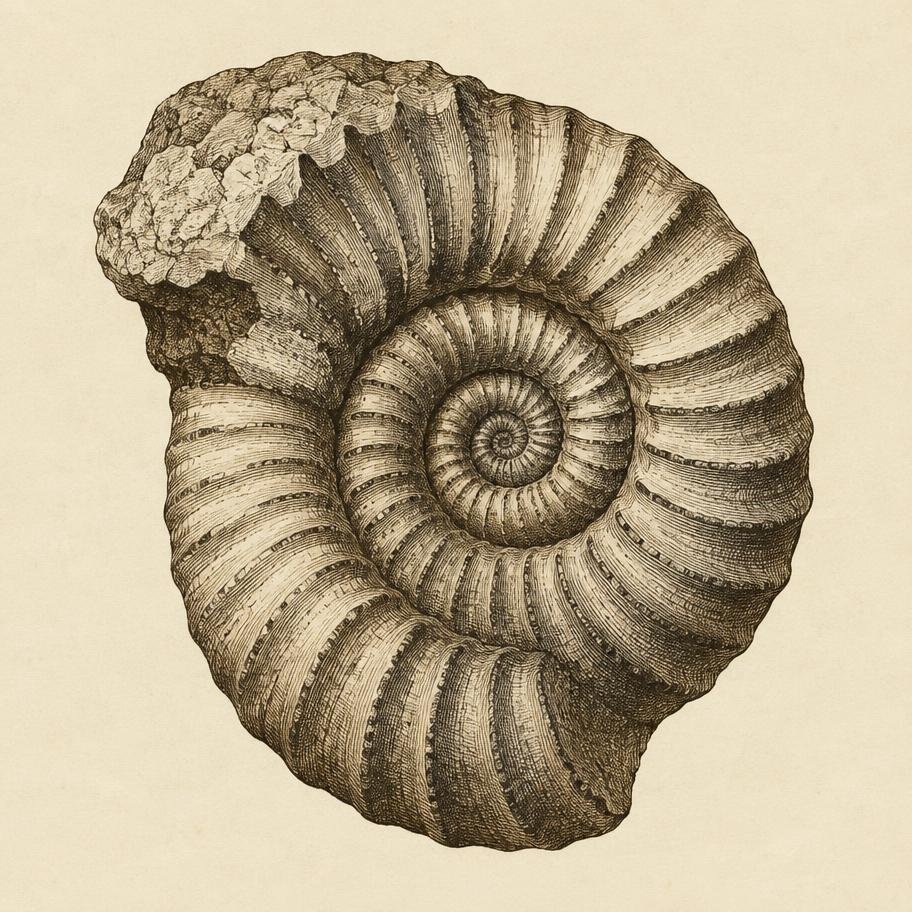
What to look for: a flat spiral that tightens evenly towards the centre, usually between two and ten centimetres across, though specimens in the Yorkshire and Dorset cliffs reach far larger sizes. The surface often carries fine ribs running outwards from the centre, sometimes branching. A broken specimen shows the internal chambers, separated by wavy walls called suture lines — the single most reliable confirmation that what you are holding is an ammonite rather than a snail.
How to tell it apart: a gastropod also spirals, but it spirals into a cone, so the coil steps out of the plane. An ammonite is flat, like a coiled rope laid on a table. Fragments are far commoner than whole specimens; a curved section of ribbed shell in a grey mudstone pebble is an ammonite fragment and is worth keeping while you learn the material.
Where to find them: the Lower Jurassic coast of Dorset around Lyme Regis and Charmouth, and the Yorkshire coast around Whitby and Runswick Bay. The Cretaceous red chalk at Hunstanton in Norfolk also produces them. Read our guide to where to find ammonites in the UK for a fuller list of sites.
2. Belemnites
Belemnites were squid-like animals with a solid internal skeleton, the guard, made of dense calcite. The soft body almost never survives, but the guard fossilises extremely well, and on many Jurassic beaches it is the commonest thing you will pick up after ammonite fragments.
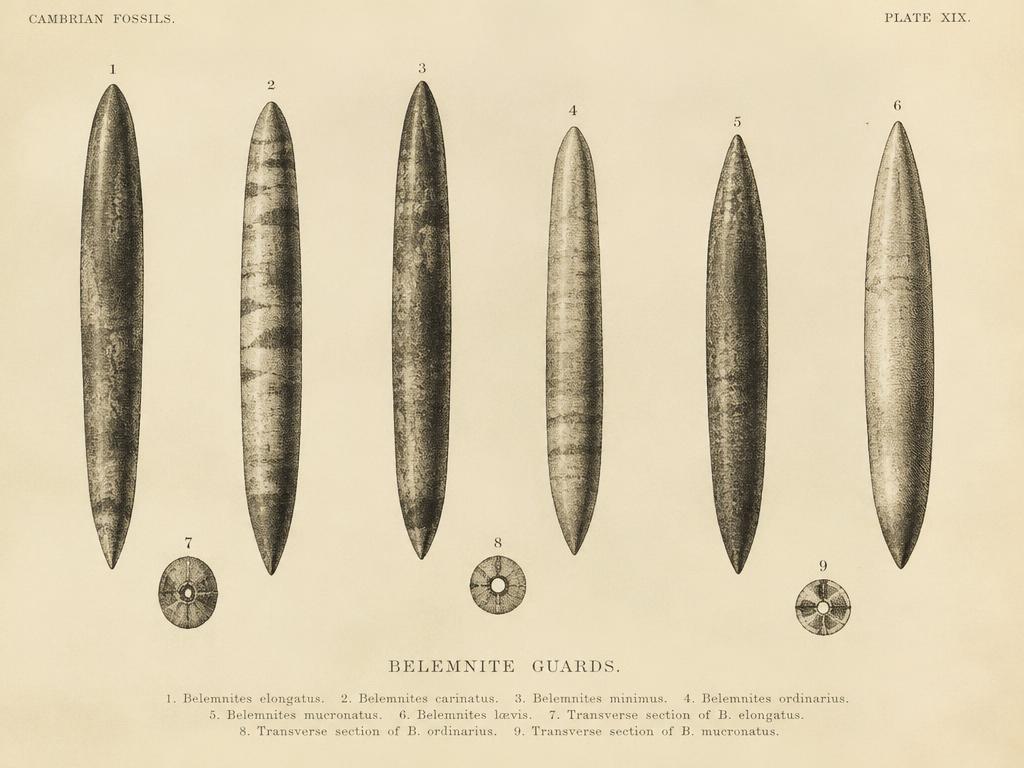
What to look for: a smooth, tapering cylinder, typically three to ten centimetres long, pointed at one end. Wet, it is the colour of dark honey or amber; dry, it can look dull grey-brown and is easy to walk past. A broken end is the giveaway — belemnite calcite has a radiating, almost fibrous crystal structure spreading out from a central line. No beach pebble imitates it.
Where to find them: the same Jurassic coasts as ammonites, particularly Dorset and Yorkshire. Port Mulgrave on the North Yorkshire coast is a well-known belemnite site, and guards are also common in the Cretaceous of Norfolk. Scan the strandline after rough weather rather than digging into the shingle.
3. Bivalves
Bivalves are molluscs with two hinged shells — the group that includes modern mussels, oysters, scallops and cockles. They are widespread in British marine sedimentary rocks from the Carboniferous onwards, and fossil bivalves turn up at the majority of coastal fossil sites in the country.
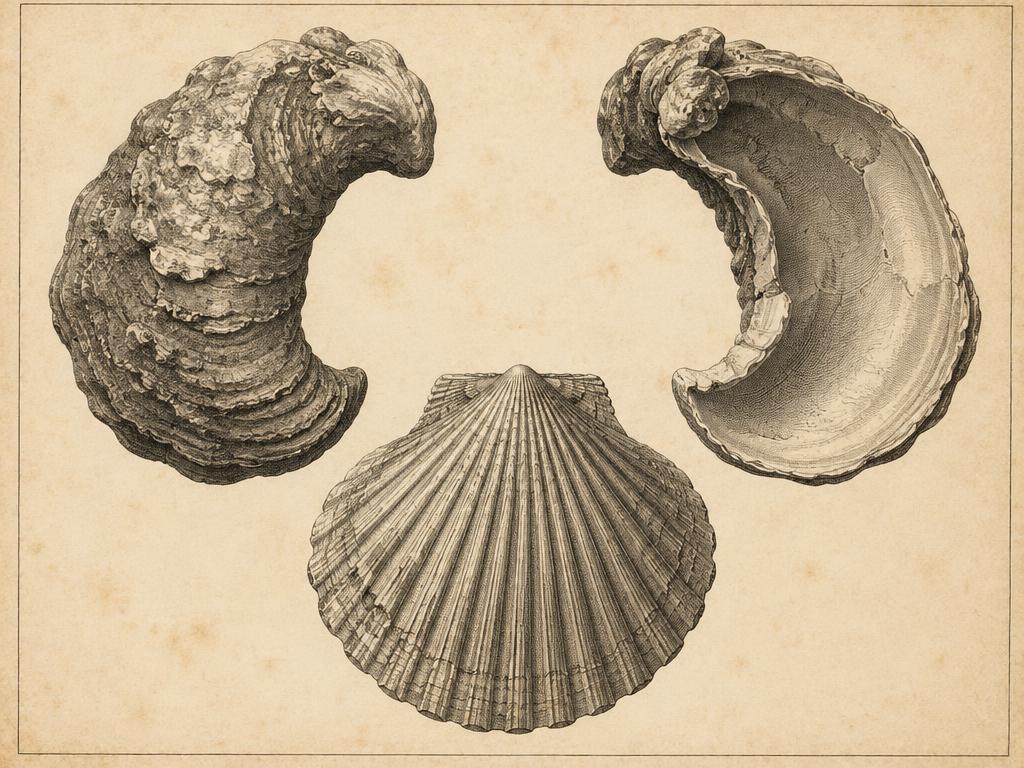
What to look for: a shell with a rounded or fan-shaped outline and a hinge line along one edge. Many are preserved as casts in stone, with the original shell dissolved away, so you may find the internal shape of the shell rather than the shell itself. Ribs usually radiate outwards from the hinge, which distinguishes them from brachiopods once you know the difference.
How to tell it apart: a bivalve is symmetrical across the join between its two shells but the individual shells are not symmetrical in themselves, whereas a brachiopod is the other way round. If you split a bivalve in imagination down the middle of one valve, the two sides do not match.
Where to find them: almost everywhere fossils are found, including the Jurassic of Dorset and Somerset, the Eocene clays of Kent and Hampshire, and the Cretaceous beds of Norfolk. Eocene shell beds often preserve shells with the original material intact and occasionally with traces of colour banding.
4. Brachiopods
Brachiopods look superficially like bivalves but belong to an entirely separate group of animals. They were hugely abundant in the Palaeozoic seas and remain a common fossil in British Carboniferous limestone, Silurian and Ordovician rocks and some Jurassic and Cretaceous beds.
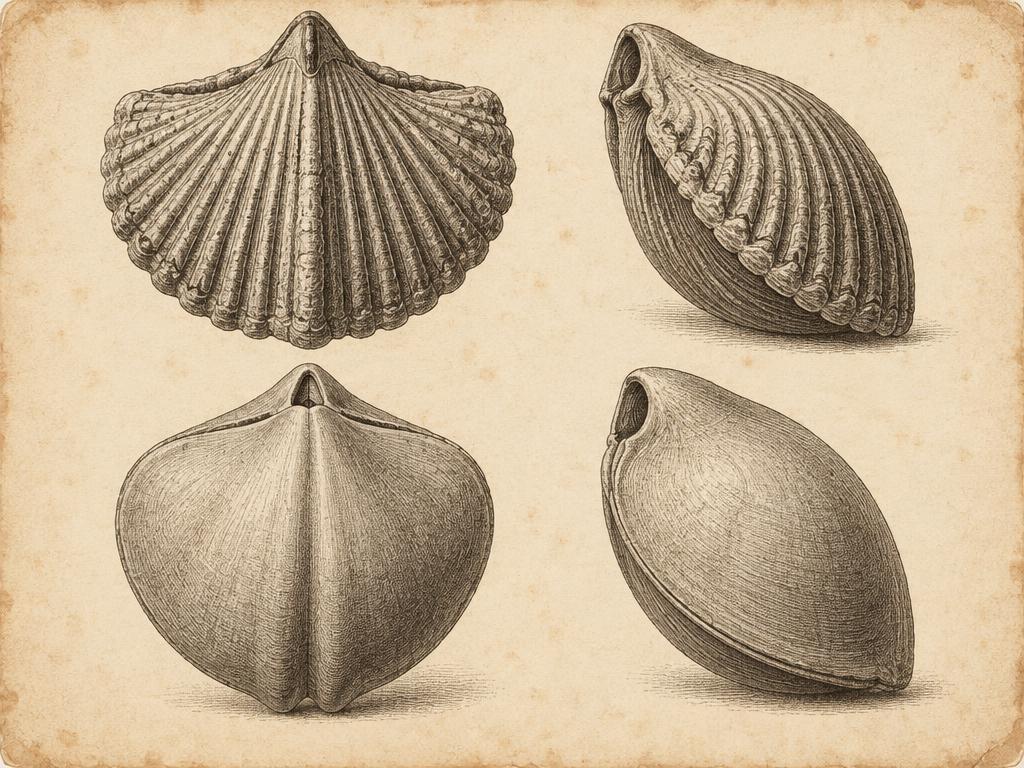
What to look for: a small shell, usually one to five centimetres, with ribs running from a pointed hinge — often with a small beak-like projection at one end where a fleshy stalk once passed through. Shapes vary from almost circular to distinctly triangular.
How to tell it apart: the symmetry test. In a brachiopod each individual valve is symmetrical left to right, and the two valves differ from one another in size or shape. The beak is the second clue; bivalves do not have one.
Where to find them: Carboniferous limestone across the Pennines, the Welsh borders and south Wales; Silurian rocks in the Welsh borders; and Cretaceous material on the Norfolk coast. Brachiopods also occur in the Jurassic of Dorset and the Cotswolds.
5. Echinoids and fossilised sea urchins
Fossil sea urchins, properly called echinoids, are found mainly in the Cretaceous Chalk, where they are preserved either as chalk casts or, more durably, as flint. Two forms are encountered often enough that most collectors learn them by name: the heart-shaped Micraster and the domed Echinocorys.
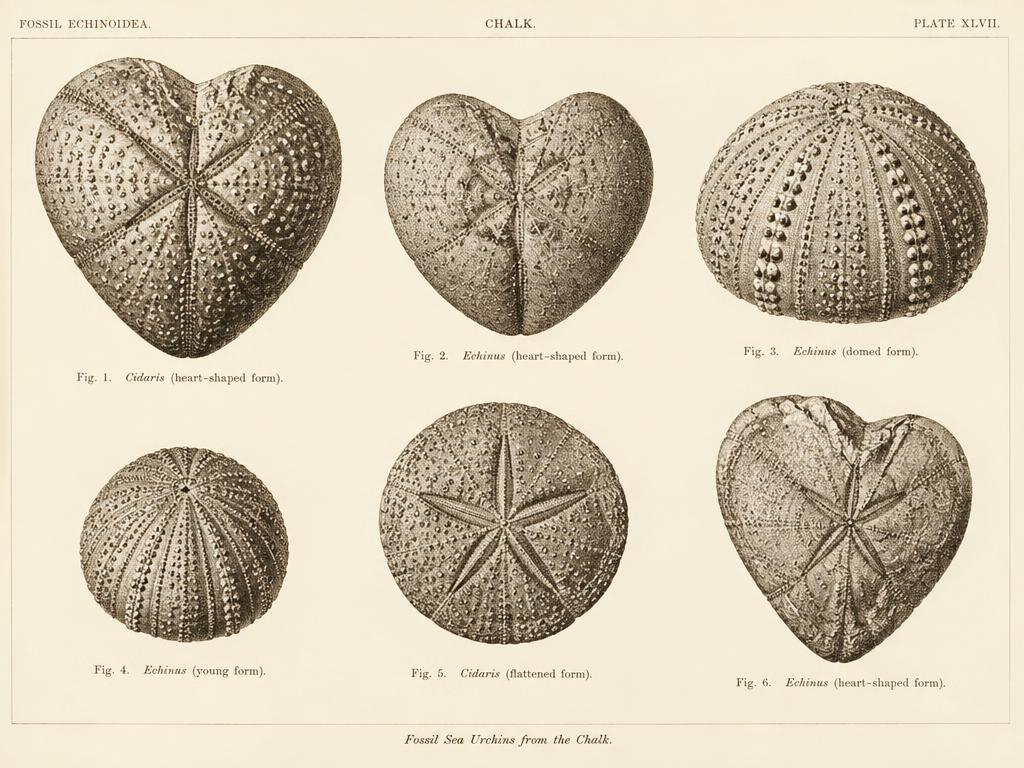
What to look for: a rounded, domed or heart-shaped object, typically three to eight centimetres across, with a five-part star pattern of tiny paired pores running over the upper surface. That fivefold symmetry is diagnostic — nothing inorganic produces it. Flint specimens are grey to honey coloured and very tough; chalk specimens are white and break easily, so wrap them.
Where to find them: chalk coastlines, particularly the Sussex and Kent cliffs and the chalk of Norfolk, Yorkshire and the Isle of Wight. Flint casts also travel in shingle a long way from their source, so they turn up on beaches where no chalk is exposed. On the Sussex coast, search the flint shingle below chalk cliffs rather than the cliff face itself.
6. Fossilised shark teeth
Sharks shed teeth throughout their lives — thousands of them — so teeth vastly outnumber every other kind of shark remain in the fossil record. In Britain, fossil shark teeth come mainly from the Eocene clays and sands of the London and Hampshire Basins and from the Pliocene Red Crag of East Anglia.
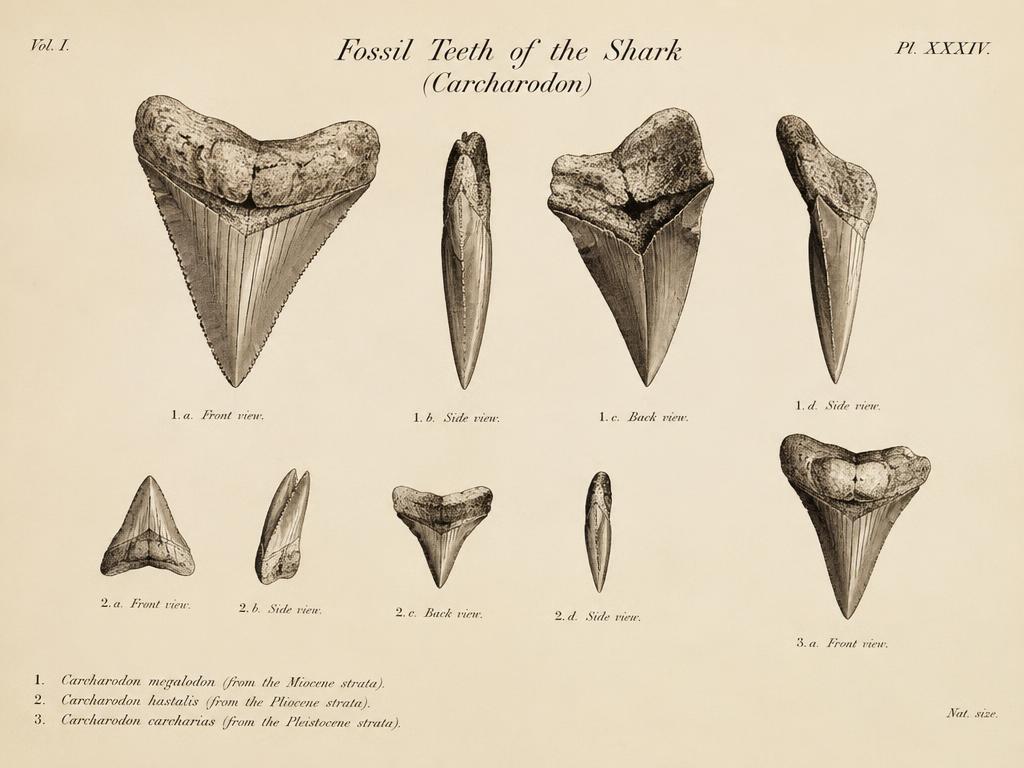
What to look for: a small triangular tooth, usually between five and thirty millimetres, with a glossy enamel crown that is darker than the surrounding sand — black, grey, slate blue or brown — and a duller, matt root beneath. The straight line where the shiny crown meets the matt root is the best confirmation.
How to tell it apart: enamel stays shiny as it dries. A dark pebble that looks promising when wet and goes flat when dry is not a tooth. Working a small patch of fine shingle slowly beats covering distance, and a three to five millimetre sieve transforms results on shell-rich beaches.
Where to find them: Walton-on-the-Naze in Essex, Herne Bay and Warden Point on the Isle of Sheppey in Kent, and Bracklesham Bay in Sussex. If you are specifically looking for teeth, see our guide to where to find shark teeth in the UK.
7. Gastropods and other molluscs
Gastropods are the snails and their relatives, and they are frequently found in British marine and freshwater sedimentary rocks. The Eocene beds of southern England produce them in particular abundance, often with the shell itself preserved rather than as a cast.
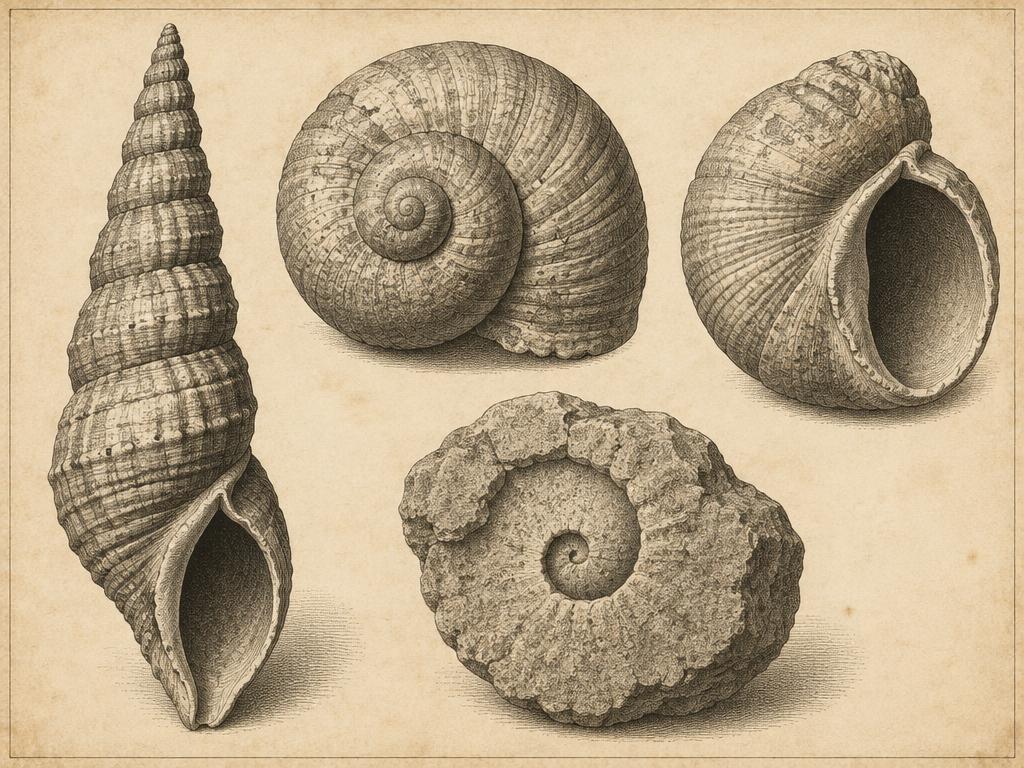
What to look for: a shell that spirals into a cone or a turret, with each whorl sitting slightly above the last. Sizes range from a few millimetres to more than ten centimetres. Surface ornament varies enormously — smooth, ribbed, knobbly or spined.
How to tell it apart: the coil rises out of the plane. If you set an ammonite down it lies flat; a gastropod sits at an angle because it is a spiral staircase rather than a coiled rope.
Where to find them: Eocene clays and sands in Kent, Essex, Hampshire and Sussex; the Pliocene crags of Norfolk and Suffolk; and Jurassic limestones in Dorset and Gloucestershire. Shell beds exposed at low tide are usually the most productive ground.
8. Crinoids
Crinoids, sometimes called sea lilies, were animals rather than plants — echinoderms related to starfish and sea urchins, anchored to the sea floor on a flexible stalk. Whole specimens are rare and spectacular. Fragments of the stalk are common.
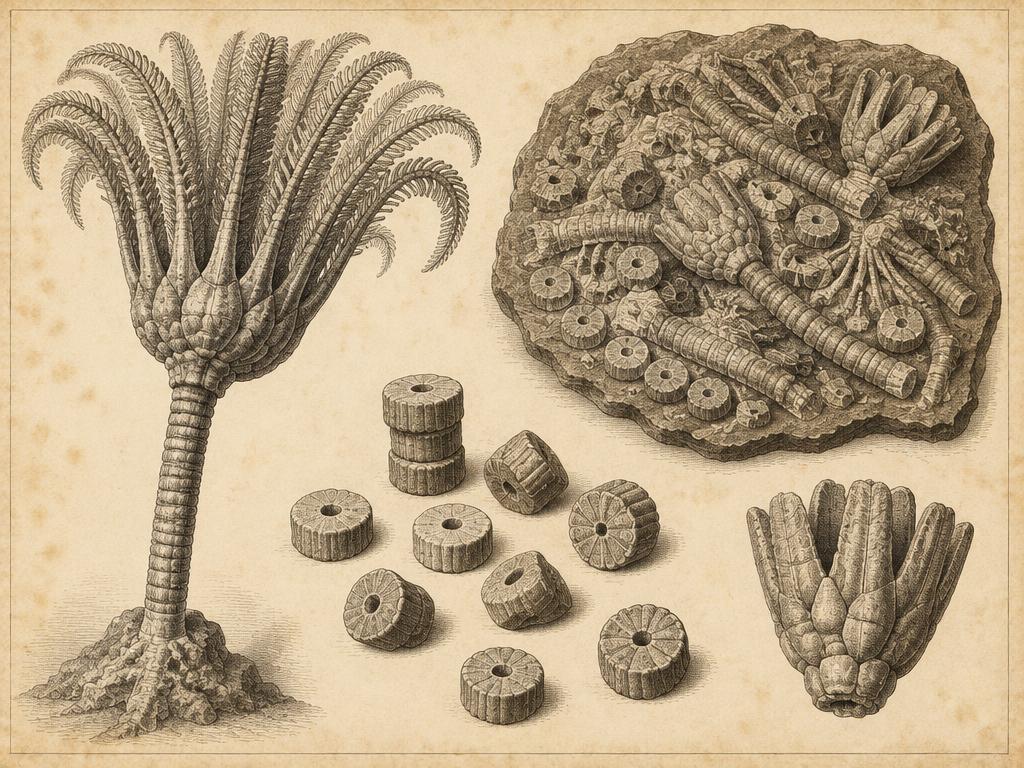
What to look for: small circular discs, often with a hole in the middle and a star-shaped or ridged internal pattern, sometimes still stacked into short columns like a roll of coins. Individual segments are typically two to ten millimetres across.
Where to find them: Carboniferous limestone across northern England, the Peak District, Wales and the Mendips, where crinoidal limestone can be made almost entirely of broken stalk fragments. Crinoid debris is also common in the Jurassic of Dorset and Yorkshire, including the shale beds around Filey Brigg.
9. Fossilised sponges
Fossil sponges are a common component of the Cretaceous Chalk and, because silica from their skeletons is the source of much flint, they are frequently preserved inside or as flint nodules. They are less immediately recognisable than ammonites or urchins, which is why many are overlooked.
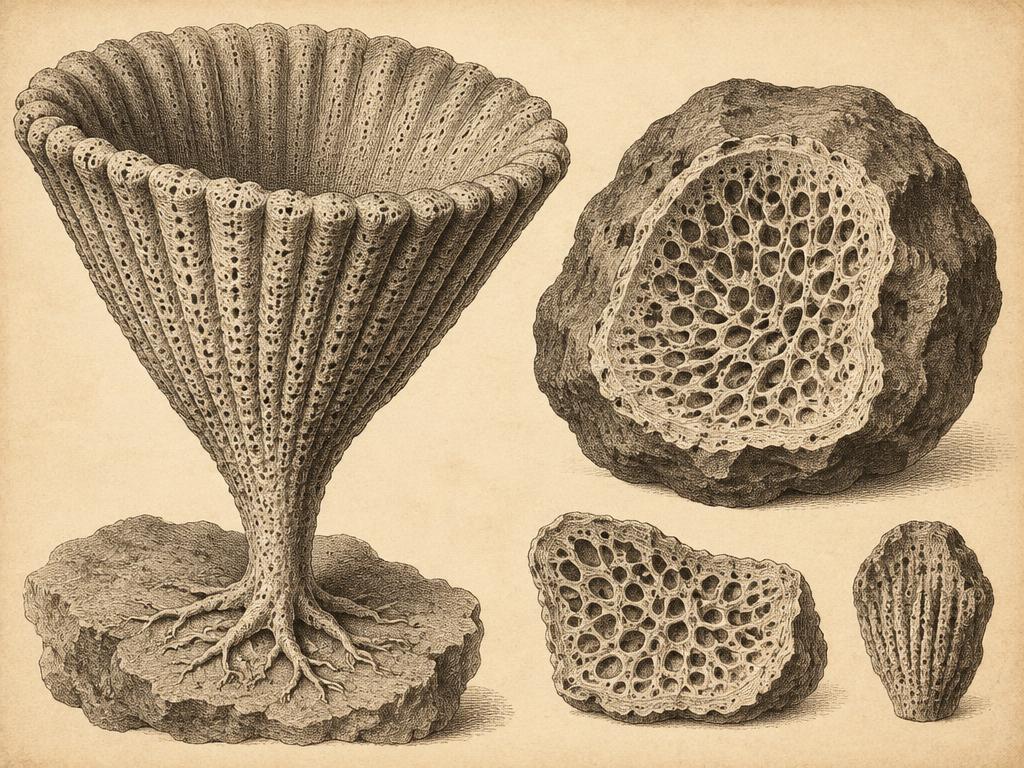
What to look for: an irregular, porous, sometimes vase-shaped or funnel-shaped object, often grey or honey-coloured flint, with a finely pitted surface texture. Some are bun-shaped; others branch. The texture is the clue — a regular network of small pores rather than the smooth conchoidal surface of ordinary flint.
How to tell it apart: ordinary flint breaks in curved, glassy fractures. A sponge keeps an organic outline and a repeating internal texture even when weathered.
Where to find them: chalk coastlines and the flint shingle derived from them — the Sussex and Kent coasts, the Norfolk chalk, the Yorkshire Wolds coast and the chalk of the Isle of Wight. Flint sponges also occur inland in fields on chalk downland.
10. Fossilised plant material and fossil wood
Fossil wood and other plant remains are found across Britain, from the Carboniferous coal measures of the Midlands, northern England, Wales and Scotland to the Cretaceous beds of the Isle of Wight and the Eocene deposits of the south-east.
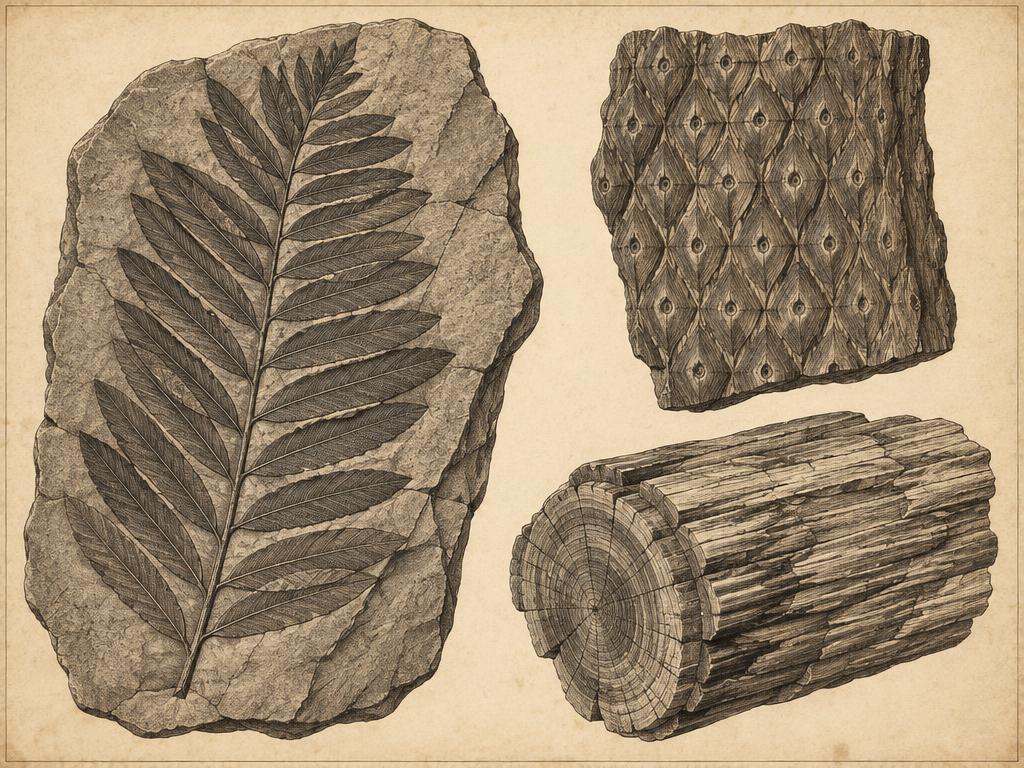
What to look for: a piece of stone that still shows the grain, growth rings or bark texture of wood. Preservation ranges from soft, black, coal-like lignite to hard, mineralised, silica-replaced wood that takes a polish. Leaf impressions are commoner in Carboniferous shales, appearing as dark films with clear venation.
Where to find them: Compton Bay and the western coast of the Isle of Wight, where fossil wood weathers out of the Wealden beds alongside dinosaur material; the Essex coast, where lignite is common in the shingle; and Carboniferous spoil and foreshore exposures in Wales and northern England.
How to look for fossils on the beach
Fossil hunting in Britain is mostly beachcombing with a trained eye. Coastal erosion does the excavation: the sea cuts into cliffs of soft mudstone, clay and chalk, releases the fossils they contain, and washes them clean in the shingle. Your job is to walk slowly over the right ground at the right time.
- Work a falling tide — arrive around two hours before low water so the beach opens up ahead of you
- Go after storms and heavy rain, when fresh material has been delivered and the shingle has been turned over
- Search loose material on the foreshore, not the cliff face
- Look at the ground a metre or two ahead of your feet, and cover a small area slowly rather than a long beach quickly
- Check freshly fallen blocks and the flat faces of broken pebbles, where whole specimens are often exposed
- Winter is the productive season: more erosion, emptier beaches and low light that picks out shapes in the shingle
Most people find fragments before they find anything whole. That is a good result — fragments teach you the colour, weight and texture of fossil-bearing material, and complete specimens follow once your eye has adjusted.
How to tell a fossil from an ordinary stone
Four properties separate fossils from pebbles, and a find that shows two or more of them is almost certainly a fossil.
- Symmetry — spirals, fivefold star patterns and matched halves are biological, not geological
- Repetition — ribs, segments, chambers and pores repeating at regular intervals
- Texture — a surface pattern that continues consistently around a curved shape
- Weight and density — pyritised and calcite fossils often feel heavier than surrounding rock of the same size
Wetting a specimen helps enormously: water brings out the pattern and the colour difference between fossil and matrix. If in doubt, photograph it in good light next to a coin for scale and ask at a local heritage centre or museum, several of which sit directly on the fossil coasts.
What should you take fossil hunting?
For a first trip on a beach you need very little, and nothing that involves hammering.
- Sturdy boots with grip — wet clay and weed-covered rock are slippery
- Waterproofs and warm layers, since the best conditions are usually the worst weather
- A tide timetable for the specific beach, checked on the day
- A small rucksack, newspaper or bubble wrap, and a box for fragile chalk or pyrite specimens
- A hand lens for small teeth, shells and surface detail
- A charged phone for photographs, location notes and safety
A geological hammer, chisels and safety glasses become useful later, and only where hammering is permitted; on many designated sites it is not. Collecting from loose beach material needs none of it.
Where can you find fossils in the UK?
Fossils occur wherever sedimentary rock reaches the surface, which in Britain means a great deal of the country — but the productive, accessible sites are overwhelmingly coastal, because the sea keeps renewing the exposure.
- Dorset — Jurassic ammonites, belemnites and marine fossils along the Jurassic Coast
- Yorkshire — Jurassic ammonites, belemnites and jet on the North Yorkshire shore
- Kent — Eocene shark teeth, shells and fish remains on the Isle of Sheppey and the north Kent coast
- Essex — shark teeth, shells and fossil wood in the shingle at Walton-on-the-Naze
- Norfolk — Cretaceous ammonites and brachiopods at Hunstanton and crag fossils further east
- Sussex and the south coast — chalk echinoids, sponges and Eocene shell beds
- Isle of Wight — Cretaceous dinosaur material and fossil wood on the western beaches
Browse fossil hunting in Dorset, fossil hunting in Yorkshire or any other region page to see the individual sites within it, with access notes, tide information and what has been recorded there.
Fossil hunting safety
The hazards on British fossil coasts are consistent and manageable: unstable cliffs, incoming tides and slippery ground. Rockfalls happen without warning, particularly after rain and frost, so keep well clear of cliff faces and never search directly beneath them or climb them. Check tide times before you set out and know your exit; several productive beaches cut off on a rising tide.
See our fossil hunting safety guide for more information about staying safe on coastal fossil sites, and check local signage and any site-specific collecting code before you start.
Fossil identification: what did you find?
If you have something you cannot place, work through the shape first. Is it flat-spiralled or cone-spiralled? Does it repeat a pattern? Is it symmetrical, and across which axis? Then check the geology of the beach you were on — a site's age largely determines what it can produce, so a tooth from an Eocene clay coast and an ammonite from a Jurassic one are expected, while the reverse would need explaining.
Each fossil page on this site sets out appearance, geological period, identification tips and the UK locations where that fossil is recorded, so you can work from the find back to the places it comes from — or from a place to what you might expect to see there.
Looking for a specific fossil? Explore the fossil database to see where different fossils can be found around the UK.
Frequently asked questions
What are the most common fossils found in the UK?
- Ammonites, belemnites, bivalves, brachiopods, gastropods, crinoid stem fragments, echinoids, shark teeth, fossil sponges and fossil wood are all commonly encountered. Which ones you find depends on the age of the rock at the site rather than the region alone.
How do you identify a fossil?
- Look for symmetry, repeating pattern, consistent texture around a curved shape, and unusual weight. Wetting the specimen brings out detail. Comparing the find against the geology of the site narrows it down quickly, and local heritage centres and museums will confirm an identification.
Where can beginners find fossils in the UK?
- Beaches with a regular supply of fresh material and no need to approach the cliffs suit beginners best — Charmouth in Dorset, Runswick Bay in Yorkshire and Bracklesham Bay in Sussex are all straightforward on a falling tide.
Can you keep fossils you find on a UK beach?
- Loose fossils on the foreshore can usually be collected on public beaches, but rules vary. Some coasts operate formal collecting codes, several sites are designated SSSIs where hammering is not allowed, and Scotland has the Scottish Fossil Code. Check local signage before collecting, and report anything that looks significant, such as articulated bone.
What is the best time of year to go fossil hunting?
- Autumn and winter generally produce more, because storms and heavy seas erode the cliffs and turn over the shingle. Tide state matters more than season: aim to be on the beach on a falling tide, ideally after rough weather.
Start finding fossils
Knowing what these ten fossils look like is most of the work. The rest is choosing a beach where they occur and timing the tide.
Looking for a fossil hunting location near you? Use near me to search a town or region, or browse all fossil hunting locations to see sites across the country with their fossils, access notes and safety information.
Locations in this guide
- 01Lyme RegisDorset · DorsetAmmonites · Belemnites · Bivalves · Marine reptile remainsBeginnerFamily friendlyBeach, CliffExplore location →
- 02CharmouthDorset · DorsetAmmonites · Belemnites · Bivalves · Fossilised woodBeginnerFamily friendlyBeach, CliffExplore location →
- 03WhitbyNorth Yorkshire · Yorkshire and the North East coastAmmonites · Belemnites · Jet · BivalvesEasyFamily friendlyBeach, CliffExplore location →
- 04Runswick BayNorth Yorkshire · Yorkshire and the North East coastAmmonites · Belemnites · Bivalves · Fossilised woodEasyFamily friendlyBeach, CliffExplore location →
- 05Filey BriggNorth Yorkshire · Yorkshire and the North East coastBrachiopods · Bivalves · Corals · Sea urchinsModerateFamily friendlyBeach, Geological siteExplore location →
- 06Port MulgraveNorth Yorkshire · Yorkshire and the North East coastAmmonites · Belemnites · Bivalves · JetExperiencedBeach, CliffExplore location →
- 07Walton-on-the-NazeEssex · EssexShark teeth · Gastropods · Bivalves · Fossilised woodEasyFamily friendlyBeach, CliffExplore location →
- 08Herne BayKent · KentShark teeth · Fossilised wood · Gastropods · BivalvesEasyFamily friendlyBeachExplore location →
- 09Warden Point, Isle of SheppeyKent · KentShark teeth · Fossilised wood · Plant fossils · GastropodsModerateBeach, CliffExplore location →
- 10Bracklesham BayWest Sussex · SussexShark teeth · Gastropods · Bivalves · CoralsEasyFamily friendlyBeachExplore location →
- 11HunstantonNorfolk · NorfolkBelemnites · Brachiopods · Bivalves · Sea urchinsEasyFamily friendlyBeach, CliffExplore location →
- 12Compton BayIsle of Wight · Isle of WightDinosaur fossils · Fossilised wood · Plant fossils · BivalvesModerateFamily friendlyBeach, CliffExplore location →