Fossil sponges
Porous, often flint-preserved sponges from the Cretaceous chalk.
Cambrian to present; British specimens are commonest in the Late Cretaceous Chalk. · Moderate to find
What is it?
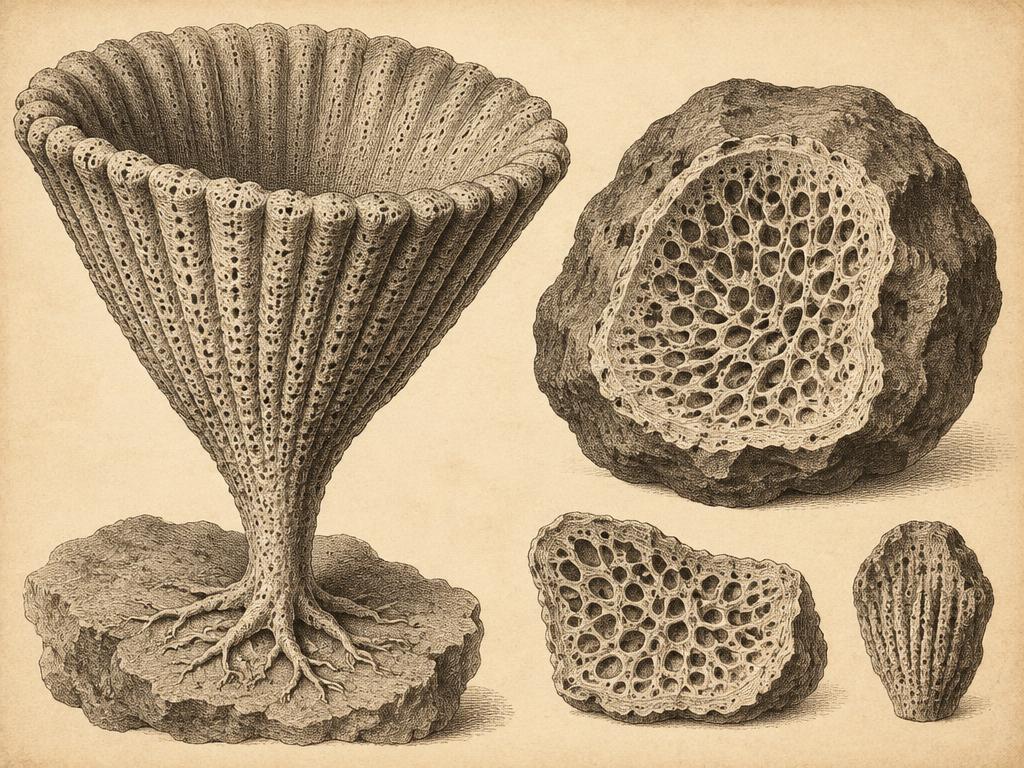
Sponges are simple filter-feeding animals with a skeleton built from silica or calcite spicules. They are a common component of the Cretaceous Chalk, and because silica from their skeletons is the source of much flint, they are frequently preserved inside or as flint nodules. Many are overlooked on the beach because they are less immediately recognisable than an ammonite or a sea urchin.
What does it look like?
An irregular, porous object, sometimes vase-shaped, funnel-shaped, bun-shaped or branching, usually in grey or honey-coloured flint, with a finely pitted surface and a repeating internal network of pores.
How to identify it
- 01Texture is the clue: a regular network of small pores rather than the smooth, glassy fracture of ordinary flint.
- 02Look for an organic outline — a cup, funnel or branching form — that survives even on well-worn pebbles.
- 03Broken faces often show the internal meshwork more clearly than the weathered outside.
- 04Wetting the specimen brings out the pore pattern.
Where to find fossil sponges in the UK
- 01Beer BeachDevon · DevonSea urchins · Belemnites · Bivalves · BrachiopodsEasyFamily friendlyBeach, CliffExplore location →
- 02HunstantonNorfolk · NorfolkBelemnites · Brachiopods · Bivalves · Sea urchinsEasyFamily friendlyBeach, CliffExplore location →
- 03West RuntonNorfolk · NorfolkMammal bones · Sea urchins · Bivalves · Fossilised woodModerateFamily friendlyBeach, Cliff, Geological siteExplore location →