Somerset · Somerset
Fossil hunting at Blue Anchor
Red and green Triassic cliffs west of Watchet, with gypsum veins and Rhaetic fossils.
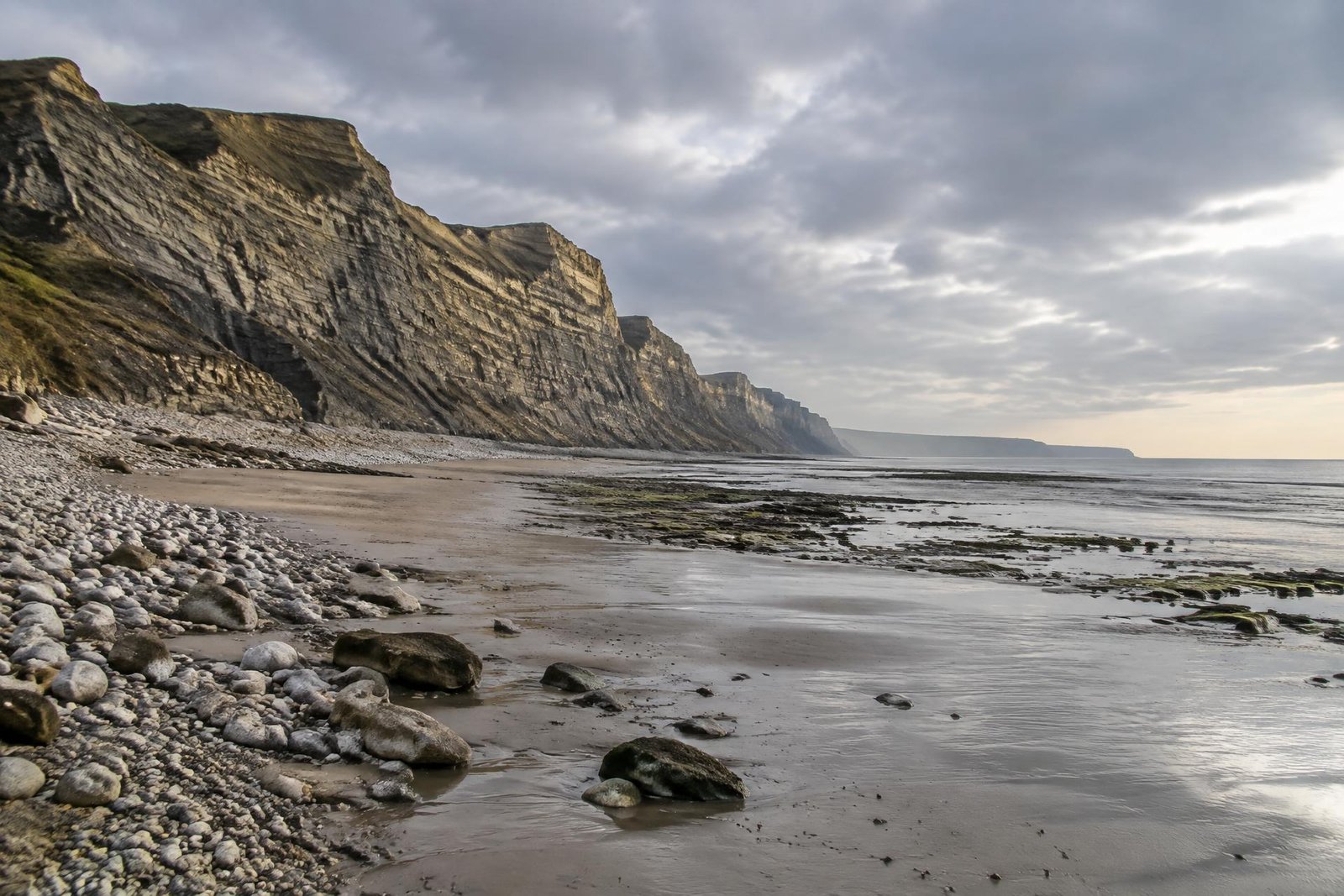
Representative photography of this stretch of coast, not a photograph of the site on a particular day.
What can you find?
About the site
Blue Anchor Bay shows the Mercia Mudstone Group in vivid red and grey-green, streaked with white gypsum. The overlying Penarth Group contains the Rhaetic bone bed horizon, which elsewhere yields fish teeth and bone fragments.
It is a geologically instructive stop rather than a place to fill a bag with fossils, and it pairs naturally with Watchet and Kilve on the same tide.
Planning a visit
- Geological period
- Late Triassic (Mercia Mudstone and Penarth Groups), around 210–201 million years old
- Difficulty
- Moderate
- Suitable for children
- Not recommended for young children at this site.
- Best time to go
- Low tide.
- Tides
- Large Bristol Channel tidal range; the foreshore floods quickly. Work the falling tide and return early.
- Access
- Beach access from the road at Blue Anchor; foreshore is rock and shingle.
- Parking
- Roadside and small car parks along the bay.
- Walking and terrain
- Short walk to the foreshore.
- Location type
- Beach, Cliff, Geological site
- Collecting
- SSSI designations apply along much of this coast. Loose material only.
Safety
- Fast tides.
- Rockfall from soft cliffs.
- Slippery ledges.
What to bring
- Boots
- Tide table
- Hand lens